
Kinds of numbers
Numbers did not arrive all at once. People first needed to count goats and cassava, then to say "none left", then to owe someone money, and then to share a loaf fairly. Each need gave us a new kind of number.
The families of numbers
| Name | Symbol | What it holds | Example |
|---|---|---|---|
| Natural numbers | Counting numbers | ||
| Whole numbers | Natural numbers and zero | ||
| Integers | Whole numbers and their negatives | ||
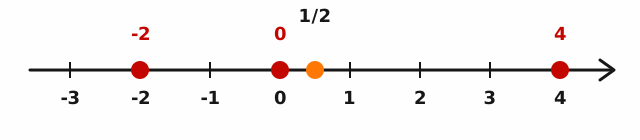
| Rational numbers | Fractions with | , , |
Every natural number is a whole number, every whole number is an integer, and every integer is a rational number.1
A number that is not rational
Some numbers cannot be written as a fraction of two integers. The length of the diagonal of a square with side 1 is , and no fraction equals it exactly. We call numbers like this irrational. Together, the rational and irrational numbers make up the real numbers.